Cloud Diary or Rain Gauge? Choosing a Weather Record
Cloud diary or rain gauge: choose the right tool for tracking changing skies or rainfall at one site, and make your notes easier to compare over time.
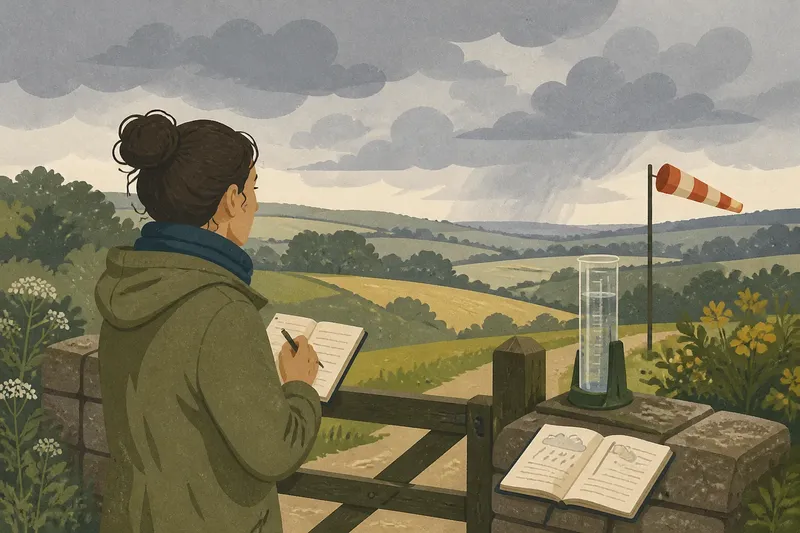
Cloud diary or rain gauge: which will tell you more about the weather where you live? A diary records changes you can see in the sky; a gauge collects rain at one fixed spot. Choose by the question you want to answer, because the two records describe different things.
Match the weather record to your question
A cloud diary suits questions about sequence: whether clouds build before a shower, how the light changes, or which way the wind seems to turn. A rain gauge suits a narrower question: how much water collected at its particular location.
Neither record predicts what will happen next. A diary describes visible conditions, while a gauge records collected rainfall. If you want to compare one location with another, you need observations from both places rather than assuming that a nearby reading applies everywhere.
A cloud diary follows changes in the sky
Use a notebook or a notes app, and choose a viewing position with a reasonably open outlook, such as a gate or kitchen window. At a regular time, describe the sky in plain terms: clear, broken cloud, or overcast; thin streaks, low grey layers, or tall bright-edged clouds.
Note changes you can see, such as cloud thickening, light dimming, or rain beginning. You can add wind direction, using a ribbon or windsock in an open spot if helpful. There is no need to identify every cloud type; a clear description is more useful than a label you are unsure about.
Write “clouds gathering from the west, breeze rising” rather than “odd sky”. If you miss a day, leave it blank instead of reconstructing it from memory. This keeps what you observed distinct from what you later infer.
A rain gauge measures collected rainfall at its position
A rain gauge is a marked container that collects rainfall for reading. Place it in an open area away from roofs, walls, overhanging branches and ground where runoff could enter. Follow the maker’s instructions for positioning and reading it.
Pick a stable place you can reach safely, and record its location. Read and empty the gauge as directed, noting the date and any problem you observed, such as a tipped container. If you move it, mark the change: readings from different positions should not be treated as if they came from one spot.
A gauge describes rainfall collected where it stands, not across a whole village, farm or valley. Local showers and nearby obstructions can make conditions different even at another site close by.
Keep the two records comparable
Choose a routine you can maintain. Use the same time and the same short descriptions for diary entries; read the gauge at a consistent time and keep it in its chosen position. A notebook, spreadsheet or notes app can all work if you use steady headings such as date, time, sky, wind, rain and comments.
Imagine you have a gauge beside the open gate of a garden and keep your diary while standing at that same gate. On a particular morning, your notes say “low grey cloud, rain began later”; at the next reading, the gauge contains collected rain. The diary records the visible change at the gate, and the gauge records what entered the container there. Neither entry says how much fell at a lane farther away.
Keep observation and interpretation separate. “Rain began after the cloud thickened” records two events you saw; “this cloud usually brings rain” is a tentative pattern to check against later entries, not a forecast.
Choose the record that fits your routine
- If you want to follow cloud, light and wind changes, choose a diary; if writing regularly is awkward, keep brief notes in a phone app instead.
- If you want a rainfall record for one site, use a gauge; if you cannot place and read one appropriately, keep descriptive rain notes rather than implying they are measurements.
- If you want to relate sky changes to collected rain, use both at the same location; if your diary view and gauge are in different places, record each location separately and avoid treating them as one observation.
- If you compare two sites, keep a record at each site; if you only have one gauge, limit your conclusion to the place where it stands.
- If the gauge is moved or disturbed, note the change or problem; if the reading may no longer represent normal collection, mark it as unreliable rather than comparing it without qualification.
- If you miss a diary entry, leave it blank; if you remember a general impression, do not present it as a dated observation.
A diary can include a simple rain description such as “none”, “light” or “steady”, but those words are estimates, not gauge readings. Keeping the two forms distinct makes later comparisons clearer.
Which weather record answers your question?
Can a cloud diary tell me whether it will rain?
It can show what the sky looked like before and during weather you observed. A recurring association in your notes is a local observation to examine, not a reliable forecast.
Does a rain gauge show rainfall across the whole area?
No; it records water collected at its own position. A nearby lane, slope or garden may receive different rain, so a reading should not be presented as a regional total.
Can I compare my notes with an official weather forecast?
Yes, but keep the forecast separate from what you observed and record its source and issue time. A forecast concerns expected conditions for an area; your diary and gauge describe conditions at a particular place.
Which should I start with if I am unsure?
Start with the question you care about: choose a diary for changing sky conditions or a gauge for collected rainfall at one site. If both questions matter, add the second record and keep its observations clearly labelled.
Keep the record tied to the place it describes
For a useful cloud diary or rain gauge record, date each entry and identify the observation point. A diary helps you describe how the sky changes; a gauge records rain collected where it stands. Keeping those locations aligned—or clearly separate—lets you compare your own patch of countryside without claiming that one spot speaks for the whole area.