Why a Hedgerow Has More Than One Season
Why a hedgerow has more than one season becomes clear as you follow blossom, fruit, leaves and bare stems, learning what each phase reveals about a boundary.
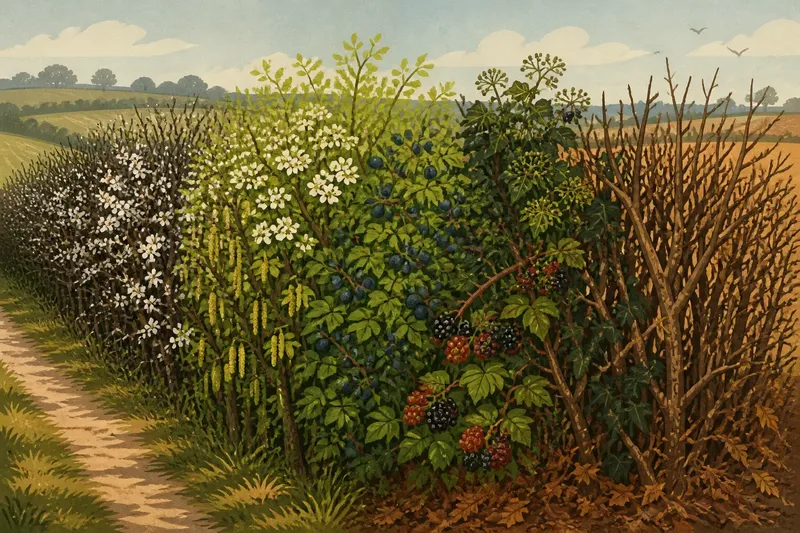
Why a hedgerow has more than one season becomes clear when blackthorn flowers on bare twigs, hawthorn later blossoms among leaves, and winter exposes the branches again. The sequence is not a tidy calendar: several plants share a boundary, and each responds to its own conditions.
Flowers, fruit, leaf cover and bare wood each make different parts of a hedge visible. Thinking in these phases helps explain why one visit can show a boundary in bloom while another reveals ripe berries or the structure hidden beneath summer foliage.
Different plants give a hedgerow overlapping seasons
A hedgerow is a close-growing boundary of shrubs and often trees, climbers and smaller plants. Blackthorn, hawthorn, hazel, bramble and ivy do not flower or fruit in unison, so their changes overlap rather than fitting into a single spring, summer or autumn phase.
Conditions and management shape what appears. A sunny bank may warm sooner than a shaded ditch, while a cut section can look unlike a neighbouring stretch. Treat what you see as a record of that particular place and day, not a timetable for every hedge.
Early blossom can appear before the leaves
Blackthorn is a familiar early-flowering shrub. Its pale blossom can stand out against dark, nearly bare stems, making the flowers easy to see before the hedge has turned green.
Hazel offers a less uniform display. Its long male catkins hang from twigs, while the small female flowers are easy to miss without looking closely. Hawthorn brings another phase of blossom, often as leaves begin to unfold.
These differences matter because flowering is not always one showy event. Note which plant is in flower and whether its stems are bare or already leafing; that simple distinction makes the succession easier to recognise on a later visit.
Fruit develops beneath an increasingly leafy canopy
After flowering, fruits form while leaves expand and fill the gaps between branches. Sloes develop on blackthorn, haws on hawthorn, and bramble fruit grows on arching, thorny canes, often around the hedge’s edge. Ivy has its own later flowering and fruiting phase.
To connect a fruit to a plant, follow its stem towards the leaves and branching pattern without pulling or tasting anything. Colour alone can mislead, and fruit may be hidden by foliage or already gone. A missing berry does not reveal whether it was eaten, fell or was simply out of sight.
Leaf cover changes the whole view of a boundary. A dense canopy can screen a field, while the lower edge and individual stems become harder to distinguish. Look from the path rather than pushing through thorny growth, and leave wildlife undisturbed.
Leaf fall reveals the hedge’s woody structure
Once leaves have fallen, forks, thorns, old cut ends and gaps become easier to see. The hedge has not become empty; its bare framework shows how branches support new growth and where the boundary has been shaped by management.
A regularly clipped stretch may have an even face, while a taller or less regularly managed section may show projecting branches or young growth. Neither appearance alone tells you whether management is appropriate. Access, local practice and wildlife needs all matter.
Ivy may retain leaves when surrounding shrubs are bare, and bramble can leave a tangle of canes. Fallen leaves also cover the ground beneath the hedge, so observe from a safe path and avoid disturbing the base.
What should you look for as the seasons change?
When does a hedgerow start flowering?
There is no single start date for every hedge. Notice which plant flowers first, whether it blooms on bare wood or among leaves, and how the display differs from other plants nearby.
How can you tell which berries belong to which plant?
Trace a fruiting stem towards its leaves and branch pattern without picking or tasting it. If you cannot identify it confidently, describe or photograph the whole stem rather than relying on fruit colour.
Why do two nearby hedge sections look different?
Their plant mix, aspect, ground conditions and management may differ. Before treating one section as a seasonal rule, note features such as shade, a ditch or recent cutting.
What details help explain a hedgerow’s seasonal phases?
Record whether you see flowers, fruit, leaves or bare structure, along with the plant if known and the location. A short description can be useful even when a name remains uncertain.
A worked seasonal record shows how the phases fit together
Imagine a reader begins with a hypothetical boundary containing blackthorn and hawthorn, then makes four visits: one in late winter, one in spring, one in late summer and one after leaf fall. These are invented observations, not a claim about a real hedge or a fixed timetable.
At the late-winter visit, the reader notes bare dark branches and pale flowers on one shrub, tentatively identifying blackthorn. The decision is to record “possible blackthorn blossom” rather than treat the name as certain.
In spring, the reader sees fresh leaves and a separate patch of blossom. The decision is to note that flowering overlaps, instead of describing the whole hedge as having one flowering moment.
In late summer, the reader sees dark fruits on a stem traced back to the likely blackthorn, while leaves still screen much of the boundary. The decision is to record the fruit and leaf cover separately, leaving the identification tentative if the stem is unclear.
After leaf fall, the reader can see forks and a gap previously hidden by foliage. The decision is to describe this as newly visible structure, not as a gap that necessarily appeared during winter.
The resulting record answers a useful question: which features changed, and which were merely concealed by leaves? Keeping those possibilities separate makes the seasonal account clearer without turning one invented sequence into a rule for every year.
Record overlapping phases rather than a fixed calendar
Why a hedgerow has more than one season is easiest to see when you keep flowers, fruit, leaves and woody structure distinct in your notes. A short description of each phase can show how the boundary changes without implying that every plant follows the same schedule.
Where you are unsure of a plant’s identity, leave it unnamed and describe what you can see. The useful last detail is often not a new blossom or berry, but the realisation that a feature was present all along and only became visible when the leaves changed.